


DLT Registration for Bulk SMS in India: A Simple Guide for Businesses
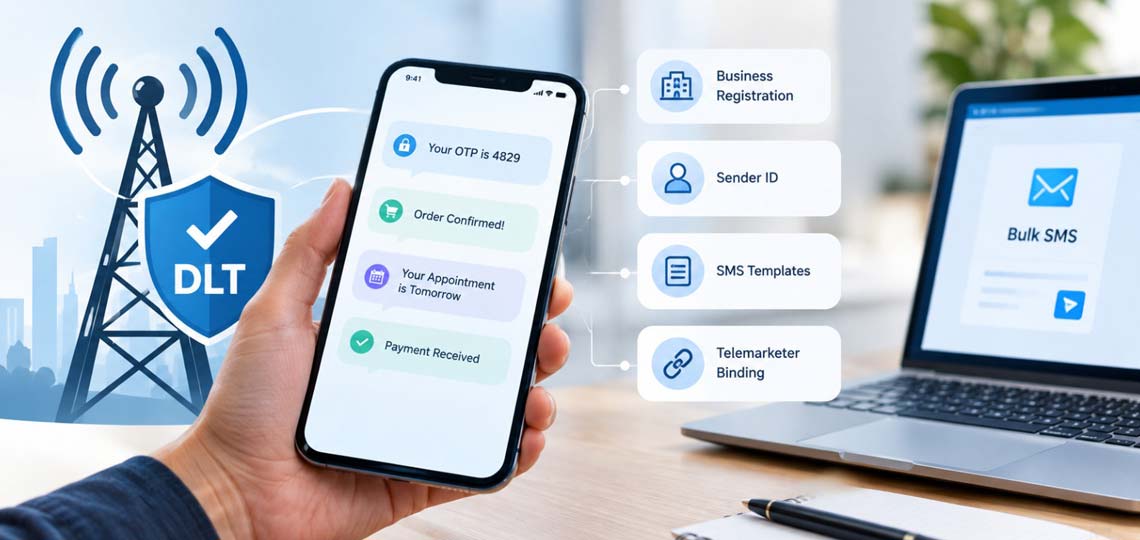
DLT Registration for Bulk SMS in India is an important requirement for businesses that use SMS to communicate with customers. Whether you want to send promotional offers, OTPs, appointment reminders, order updates, payment alerts or other business notifications, understanding the DLT process is essential.
DLT stands for Distributed Ledger Technology. It is a system used by telecom operators to regulate commercial communication and help reduce spam and unwanted messages.
For businesses using a Bulk SMS Service in India, DLT registration helps ensure that the business, Sender ID and SMS templates are properly registered before messages are sent.
In this guide, we will explain DLT registration in simple language, including the documents required, registration process, Sender ID, SMS templates, telemarketer binding and how a bulk SMS platform can help businesses manage their campaigns.
What is DLT Registration?
DLT registration is the process through which a business registers itself with a telecom operator's DLT platform for sending commercial SMS.
The DLT framework helps identify:
- The business sending the SMS
- The Sender ID or Header
- The SMS template being used
- The SMS service provider or telemarketer
This creates a more transparent communication system and helps telecom operators control spam and unsolicited commercial communication.
In simple terms, if your business wants to send Bulk SMS in India, you need to complete the applicable DLT registration and approval process before running your campaigns.
Why is DLT Registration Important for Bulk SMS?
Businesses use SMS for many purposes, such as:
- Marketing and promotional offers
- OTPs
- Appointment reminders
- Order confirmations
- Payment notifications
- Delivery updates
- Booking confirmations
- Customer alerts
- Service notifications
Because commercial SMS can reach a large number of customers, telecom regulations require businesses and service providers to follow specific processes.
DLT registration helps businesses use SMS in a more structured and compliant manner.
It also helps customers identify the source of commercial communication and reduces the chances of unwanted or misleading messages being delivered.
Who Needs DLT Registration?
Businesses and organizations using commercial SMS may need to complete the applicable DLT registration process.
This can include:
- Private Limited Companies
- Public Limited Companies
- LLPs
- Partnerships
- Proprietorships
- Ecommerce businesses
- Hospitals and healthcare organizations
- Educational institutions
- Real estate companies
- Financial businesses
- Travel companies
- Retail businesses
- Startups
- Service providers
The exact documentation and requirements can vary depending on the type of organization and the nature of the SMS communication.
Documents Required for DLT Registration
Before starting your DLT Registration, keep your business documents ready. The exact requirements can vary between DLT operators, but businesses may generally need the following.
1. PAN Card
A PAN is generally required to establish the identity of the business or proprietor.
2. Business Registration Documents
Depending on your business structure, you may need documents such as:
- GST Registration Certificate
- Certificate of Incorporation
- LLP registration documents
- Shop & Establishment Certificate
- TAN
- Other applicable business registration documents
You may not need every document mentioned above. The requirements depend on your business type and the selected DLT operator.
3. Letter of Authorization
If an employee or representative is handling the DLT account on behalf of the business, a Letter of Authorization (LOA) may be required.
The letter confirms that the person is authorized to manage the registration for the business.
4. Authorized Signatory ID Proof
An identity document of the authorized signatory may also be required, depending on the DLT operator's process.
DLT Registration Process: Step-by-Step
The DLT process can be broadly divided into four stages:
Principal Entity Registration → Sender ID Registration → Telemarketer Binding → SMS Template Registration
Let's understand each step.
Step 1: Principal Entity Registration
The first step is registering your business as a Principal Entity (PE).
The general process includes:
- Select a DLT platform.
- Create your account.
- Select Principal Entity or Enterprise registration.
- Enter your business details.
- Enter authorized signatory details.
- Upload the required documents.
- Complete mobile and email verification.
- Submit the application.
After successful verification and approval, the business receives a unique Principal Entity ID (PE ID).
This ID identifies your business within the DLT ecosystem and may be required when connecting your account with a bulk SMS service provider.
Step 2: Sender ID or Header Registration
The next step is Sender ID Registration.
A Sender ID, commonly known as a Header, identifies the sender of an SMS.
For example, a business may want customers to recognize its messages through its brand name.
The general process is:
- Log in to your DLT account.
- Go to the Header or Sender ID section.
- Select the applicable communication category.
- Enter the proposed Sender ID.
- Provide the required information.
- Submit it for approval.
Once approved, the Sender ID can be used for the applicable SMS communication.
Step 3: Telemarketer or SMS Provider Binding
The next step is connecting your business with the Telemarketer or SMS Service Provider that will deliver your messages.
Your SMS provider will generally provide the required telemarketer information and guide you through the binding process.
The purpose of this step is to establish the relationship between your registered business and the service provider that will send SMS on your behalf.
Once the required request is raised, the business may need to approve or confirm the connection through the DLT portal.
Step 4: SMS Template Registration
One of the most important steps is SMS Template Registration.
Before sending an SMS campaign, the message format needs to be registered and approved according to the applicable DLT requirements.
For example, a hospital may register:
Dear {#var#}, your appointment with Dr. {#var#} is confirmed for {#var#} at {#var#}.
The {#var#} fields represent information that can change for each customer.
The final message could look like:
Dear Rahul, your appointment with Dr. Mehta is confirmed for 28 September at 5:30 PM.
Once the template is approved, it receives a Template ID.
Your bulk SMS platform can then use the relevant DLT information when sending the campaign.
What is a DLT SMS Template?
A DLT SMS template is an approved format for a business message.
For example:
Dear {#var#}, your order {#var#} has been shipped. Track your order here: {#var#}.
The business can replace the variables with customer-specific information while following the approved template structure.
Businesses should be careful when changing SMS content because a significantly different message may require a separate template or approval.
DLT and Promotional SMS
Promotional SMS are messages used to market products, services, offers or discounts.
Examples include:
- Get 20% off your next purchase.
- New collection now available.
- Book your holiday package today.
- Special weekend offer for you.
Promotional communication is subject to applicable DLT and telecom requirements. Businesses should therefore ensure that the correct message category, Sender ID and approved template are used.
DLT and Transactional or Service Messages
SMS is also widely used for customer notifications that are not primarily promotional.
Examples include:
- OTPs
- Appointment reminders
- Order updates
- Payment alerts
- Booking confirmations
- Delivery notifications
- Account updates
The applicable category depends on the nature of the communication, so businesses should select the appropriate classification while registering their templates.
Popular DLT Platforms in India
Businesses may come across DLT platforms operated by major telecom providers such as:
- Jio
- Airtel
- Vodafone Idea
- BSNL
DLT portal names, processes, documentation and requirements can change over time. Businesses should always check the current requirements of the selected telecom operator before completing registration.
How Bulk SMS Software Helps Businesses
DLT registration is only one part of running an SMS campaign. Businesses also need an efficient platform to create, manage and track their SMS campaigns.
A Bulk SMS Software can help businesses:
- Upload customer databases
- Create SMS campaigns
- Use approved Sender IDs
- Select approved templates
- Schedule campaigns
- Send bulk messages
- Integrate SMS APIs
- Manage customer communication
- Track campaign activity
For businesses sending regular SMS campaigns, managing these activities from one platform can save time and reduce manual work.
A platform such as Tech Pioneer Platforms can help businesses manage customer communication through bulk SMS and other digital communication channels from a centralized platform.
Common DLT Registration Mistakes
Businesses should avoid some common mistakes while setting up DLT and bulk SMS campaigns.
Using an Unapproved Sender ID
Always use the appropriate registered Sender ID for the applicable SMS communication.
Changing Approved Templates
Do not assume that an approved template can be changed freely. Significant changes may require a new template.
Not Completing Provider Binding
Make sure your SMS service provider is correctly connected with your Principal Entity through the applicable DLT process.
Incorrect DLT Information
Keep your Principal Entity ID, Sender ID and Template IDs properly recorded and correctly configured with your SMS provider.
Starting Registration at the Last Minute
DLT approval can take time. Complete your registration and template approvals before planning important campaigns.
DLT Registration Checklist
Before starting your Bulk SMS Campaign in India, make sure you have:
- Business PAN
- Applicable business registration documents
- Authorized signatory details
- Letter of Authorization, where required
- Principal Entity registration
- Principal Entity ID
- Approved Sender ID/Header
- SMS provider/telemarketer connection
- Approved SMS templates
- Template IDs
- DLT details configured with your SMS platform
Frequently Asked Questions
Is DLT registration mandatory for bulk SMS in India?
Businesses sending commercial communications need to follow the applicable DLT and telecom requirements. The exact requirements depend on the type and category of SMS traffic.
What is a DLT Principal Entity ID?
A Principal Entity ID, or PE ID, is the unique identification associated with a registered business in the DLT ecosystem.
What is a DLT Sender ID?
A Sender ID or Header identifies the sender associated with an SMS and needs to be registered according to applicable requirements.
What is a DLT Template ID?
A Template ID is the unique identification associated with an approved SMS template.
Can I send bulk SMS without DLT registration?
Businesses should complete the applicable DLT registration and approval requirements before sending commercial SMS.
Do I need to register every SMS?
No. Businesses generally register message templates. Customer-specific information can be inserted into the approved variable fields according to the applicable rules.
Conclusion
DLT Registration for Bulk SMS in India is an important part of setting up business SMS communication.
The process can be summarized simply:
Register your business → Get your Principal Entity ID → Register your Sender ID → Connect your SMS provider → Register your SMS templates → Configure your bulk SMS platform → Start your campaigns.
Whether you are an ecommerce company, hospital, educational institution, real estate business, financial organization, retailer or service provider, having the correct DLT setup helps you manage your SMS communication more effectively.
With a reliable Bulk SMS Service Provider and Bulk SMS Software, businesses can manage campaigns, customer notifications, SMS APIs and communication from a single platform.
Looking for a reliable Bulk SMS solution for your business?
Explore Tech Pioneer Platforms and simplify your customer communication with Bulk SMS and other business communication solutions.
