


How to Automate Customer Support Without Losing the Personal Touch
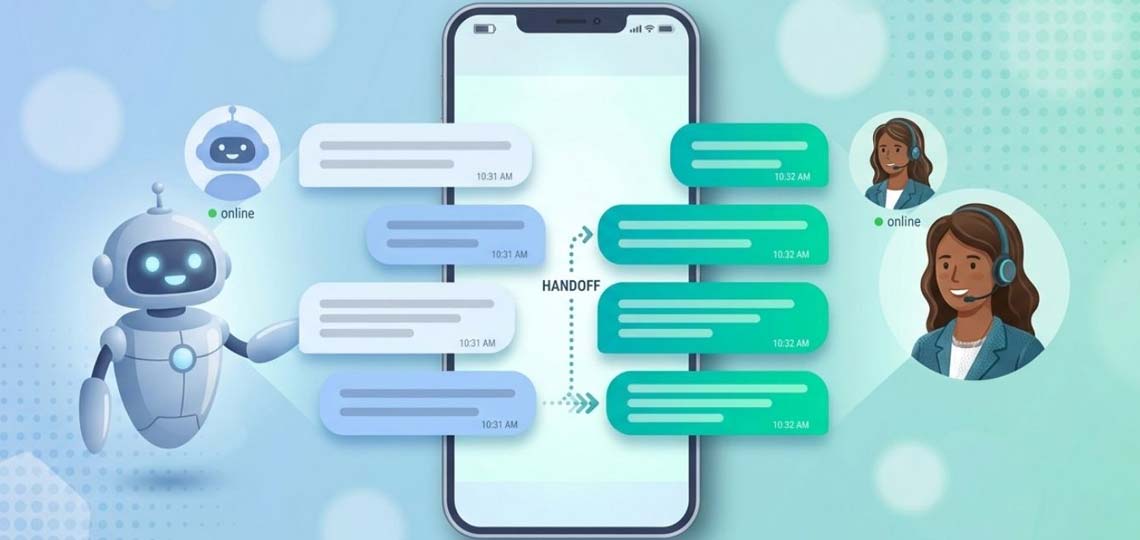
It's 11:00 PM. A customer has a problem and sends your business a WhatsApp message. Within seconds, they receive a response. So far, so good.
Then they ask a question the chatbot wasn't designed to handle. The bot repeats the same response. The customer tries again. Another irrelevant answer appears. Finally, the customer types, "I want to speak to a real person."
What started as a fast customer experience has now become a frustrating one.
This is the real challenge businesses face with customer support automation. The question is no longer whether businesses should use AI or chatbots. The bigger question is where automation creates value and where human involvement becomes essential.
The strongest customer support strategies don't try to eliminate human conversations. They use automation to handle what technology does best and give people more time to handle what requires judgement, empathy, and experience.
In other words, the objective isn't 100% automation. It is the right level of automation.
What AI Chatbots Are Actually Good At
AI chatbots are extremely effective when they are given the right responsibilities. They can respond instantly, operate 24/7, handle multiple conversations simultaneously, and manage repetitive customer interactions without putting additional pressure on support teams.
Consider the questions your team receives every day:
- What are your business hours?
- What is the price of this service?
- Where is my order?
- Can I book an appointment?
- What documents do I need?
- Do you deliver to my location?
- Can someone from sales contact me?
These are predictable interactions that don't always require a human employee. This is where AI chatbot customer support and chatbot automation can deliver immediate value. The important point, however, is to automate the right conversations, not every conversation.
Repetitive, High-Volume Queries
If your support team is answering the same questions hundreds of times every week, that is usually the clearest opportunity for automation. A customer asking about delivery timelines doesn't necessarily need a support executive to manually type the answer every time. A chatbot can provide the information immediately.
The same principle applies across industries:
- A real estate company can automate property enquiries and collect buyer requirements.
- A hospital can automate appointment-related queries.
- An e-commerce business can provide order-status updates.
- An educational institution can answer admission-related FAQs and collect student information.
Instead of using employees for repetitive information delivery, businesses can use them for conversations that require decision-making and personal attention. That is the real value of customer support automation.
The First Response Is Often More Important Than the Final Response
One of the biggest mistakes businesses make is expecting automation to resolve every customer interaction. Automation doesn't have to complete the entire conversation to be valuable. Sometimes, its most important job is simply to respond immediately.
A customer who receives an acknowledgement within seconds feels that the business is available. A customer who waits several hours before receiving the first response may already have moved to a competitor.
A chatbot can acknowledge an enquiry, understand the customer's requirement, collect relevant information, and route the conversation to the right team.
For example, instead of simply responding:
"Thank you for contacting us. Our team will get back to you."
An intelligent chatbot could ask:
- "What type of property are you looking for?"
- "Which location do you prefer?"
- "What is your approximate budget?"
By the time a salesperson joins, the conversation already has context. The salesperson isn't starting from zero.
Cost Efficiency Without Sacrificing Service
A human support team can only manage a limited number of conversations simultaneously. A chatbot can manage thousands of conversations at scale, depending on the infrastructure and use case, without requiring a proportional increase in manpower.
This makes automation particularly valuable for businesses dealing with high enquiry volumes, seasonal spikes, or customers outside traditional working hours.
But the objective shouldn't simply be reducing headcount. The smarter objective is reducing repetitive workload while increasing the productivity of your existing team.
Automation handles volume. Your people handle value.
Consistency Across Every Customer Interaction
Customer experience should not depend on which employee happens to answer a message. A well-designed chatbot can consistently provide approved information about pricing, policies, products, processes, availability, and frequently asked questions.
That means fewer inconsistencies, fewer missed details, and fewer situations where one customer receives a different answer from another.
Consistency becomes particularly important as businesses scale. The larger the customer base, the harder it becomes to maintain the same response quality through manual processes alone.
Faster Response Can Mean Faster Conversion
Speed is not just a customer support metric. It can directly influence sales.
When someone enquires about a property, vehicle, course, healthcare service, financial product, or any other high-consideration purchase, they may be contacting several businesses simultaneously. The business that responds first has an opportunity to start the conversation first.
Chatbot automation can instantly respond to the enquiry, identify the customer's intent, collect qualification information, and notify the appropriate salesperson. This turns automation from a simple support tool into part of the lead qualification and conversion process.
The Problem With "Fully Automated" Customer Support
Here is where businesses need to be careful. Full automation should not be the goal.
Customers don't measure your business by how much AI you use. They measure it by how easily they can get their problem solved.
A chatbot that handles simple questions brilliantly but cannot recognise when a conversation needs human intervention can damage the very customer experience it was introduced to improve.
The problem becomes especially obvious when a customer has an unusual question: the bot doesn't understand it, the customer explains again, the bot still doesn't understand it, and the customer asks for a human only to receive another automated response.
At that point, automation is no longer helping. It is becoming an obstacle.
The strongest customer support automation software therefore needs something just as important as automation: a clear human handoff strategy.
Where Automation Should Stop, and a Human Should Start
Knowing when to stop automation is not a technical limitation. It is a business decision.
Certain conversations should automatically receive human attention because they involve judgement, emotion, money, or significant customer value. These include:
- Complaints and escalations
- Refund and payment disputes
- Angry or frustrated customers
- Complex technical problems
- High-value sales enquiries
- Sensitive customer situations
- Requests that require approval or judgement
- Questions the chatbot has failed to understand repeatedly
- Customers explicitly requesting human assistance
A sophisticated support system doesn't wait for the customer to become extremely frustrated before offering help. It recognises the signals early and moves the conversation to the right person.
Recognising When a Customer Is Getting Frustrated
Customer frustration often appears in the conversation before the customer explicitly complains. Repeated questions are one signal. Short or increasingly direct responses are another.
Phrases such as these are strong indicators that the conversation should no longer remain fully automated:
- "I already told you."
- "That's not what I asked."
- "Talk to a person."
- "I need help now."
Even simple signals such as repeated attempts to ask the same question, excessive punctuation, or all-caps messages can indicate that the customer is becoming frustrated.
The earlier the system recognises these signals, the easier it is to protect the customer experience. The objective isn't to prove that the chatbot can continue the conversation. The objective is to make sure the customer gets the right help.
Complex, High-Stakes, or Emotional Conversations
Some conversations should be routed to a human almost by default. Refunds are a good example: if a customer says, "I was charged twice," they don't want to navigate another FAQ. They want someone to investigate the issue.
The same applies to complaints, failed services, payment disputes, and situations where the customer has already had a negative experience.
High-value enquiries also deserve careful consideration. A customer discussing a major real estate purchase, an enterprise software contract, or another significant investment may expect personal assistance rather than a purely automated interaction.
Automation can initiate the conversation. A human can build the relationship.
What a Good Chatbot-to-Human Handoff Actually Looks Like
A human handoff should feel like a continuation of the conversation — not a restart. This is where good customer support automation software makes a significant difference.
When a support executive joins the conversation, they should immediately have access to the relevant context:
- Complete conversation history
- Customer details
- Information already collected
- Previous questions and responses
- Customer requirements
- Reason for escalation
The customer shouldn't have to explain the same issue for the third time.
Imagine a customer starts a conversation with a chatbot:
Customer: "I want to book an appointment."
The chatbot collects the preferred date, service, and basic information. A support executive then joins. Instead of asking, "Hi, how can I help you?" the executive can say:
"Hi Rahul, I can see you're looking for an appointment this Friday. Let me check the available slots for you."
That is what a seamless handoff looks like. The technology stays in the background. The customer simply experiences a business that is responsive and organised.
There should also be no uncertainty about what happens next. Once the conversation is transferred, the customer should know that a human is handling the request.
A Simple Framework for Deciding What to Automate
You don't need to automate your entire customer support operation overnight. Start with your five most common customer questions, then evaluate each one using three simple criteria:
- Is it repetitive? If your team answers the same question repeatedly, automation may be appropriate.
- Is the answer factual and predictable? If there is a clear answer that doesn't require judgement, it is usually a strong candidate for automation.
- Does it involve money, emotion, judgement, or complexity? If yes, consider routing the conversation to a human.
A simple framework is:
- Repetitive + factual = Automate
- Complex + emotional + high-value = Human
- Everything in between = Automate the first step, then allow a human to take over when required.
This approach gives businesses the best of both worlds: the speed and scalability of automation with the trust and understanding of human support.
The Best Automation Is the One Customers Don't Notice
The purpose of customer support automation isn't to make customers talk to a machine. It is to make getting help faster, easier, and more consistent.
Done badly, automation feels like a wall between your customer and your business. Done well, it feels almost invisible.
The customer gets an immediate response. Simple questions are resolved instantly. Relevant information is collected. Complex issues reach the right employee. And the customer never feels abandoned inside an automated system.
That is the balance businesses should aim for: automate the repetitive, accelerate the simple, assist the complex, and humanise the important.
Automate the repetitive. Accelerate the simple. Assist the complex. Humanise the important.
At Tech Pioneer Platforms, we build chatbot automation designed around this approach — helping businesses automate customer conversations while keeping intelligent, seamless human handoffs exactly where they matter.
