


Customer Didn’t See Your WhatsApp Message? How to Use SMS and Email as a Fallback
When a Missed Message Becomes a Lost Opportunity
Your sales team responds to a customer enquiry on WhatsApp, but the customer never replies. An appointment reminder goes unnoticed, a payment notification remains unread, or a potential buyer stops responding after showing interest.
For businesses, these situations can lead to missed appointments, delayed payments, and lost sales opportunities.
WhatsApp has become an essential business communication channel, but relying on a single platform can create gaps in customer engagement. Messages may go unnoticed because of disabled notifications, busy schedules, or limited internet connectivity.
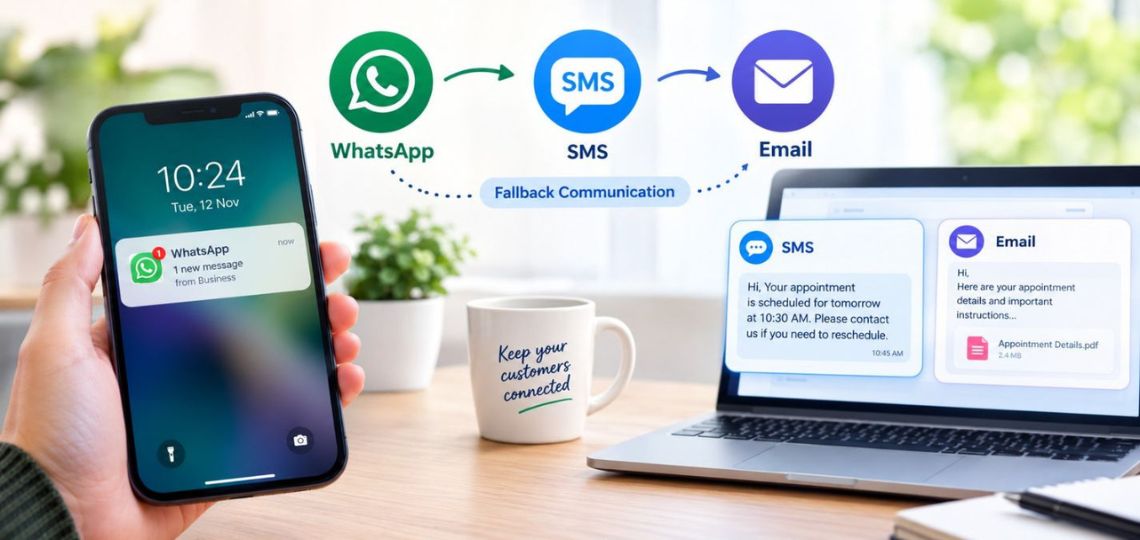
The solution is to build a communication strategy that combines WhatsApp, SMS, and email. When one channel does not achieve the desired outcome, another can help deliver important information and encourage the customer to take action.
Let's explore how businesses can use these channels together to improve communication and manage follow-ups more effectively.
Why WhatsApp Messages Go Unnoticed
Even when a WhatsApp message is sent successfully, it does not guarantee that the customer will read it or respond.
Common reasons include:
- Too many messages: Important business conversations can get buried among personal and promotional messages.
- Disabled notifications: Customers may mute chats or turn off notifications.
- Internet connectivity issues: Customers may temporarily be unable to access WhatsApp.
- Poor timing: A customer may receive a message during a meeting, while travelling, or during working hours.
- Missing follow-ups: Businesses may lack a structured process to reconnect with customers who do not respond.
The problem is not always the communication channel. Often, businesses need a better way to identify missed interactions and decide what to do next.
What Is a Fallback Communication Strategy?
A fallback communication strategy uses an alternative channel when the primary channel does not achieve the intended outcome.
For example, a business sends an appointment confirmation through WhatsApp. If the customer does not acknowledge it within a suitable period, the system may send an SMS reminder. An email can provide additional information, such as appointment instructions or supporting documents.
A typical workflow involves five steps:
1. Send the initial WhatsApp message.
2. Monitor available delivery, read, or customer-action statuses.
3. Apply a suitable waiting period.
4. Send an SMS or email when the defined conditions are met.
5. Update the customer record and stop unnecessary follow-ups when the customer responds.
This approach helps businesses maintain communication without depending entirely on one channel.
However, an unread message does not always mean a customer has lost interest. Follow-ups should be relevant, appropriately timed, and aligned with customer preferences.
Using SMS as a Fallback Channel
SMS is useful for short, direct, and time-sensitive notifications. Unlike internet-based messaging applications, standard SMS does not require mobile data to receive a text message, although mobile network availability and other factors can affect delivery.
Businesses can use SMS for several purposes.
Appointment reminders: Hospitals, clinics, educational institutions, and service centres can send reminders about upcoming appointments.
Payment notifications: Businesses can remind customers about pending invoices, upcoming due dates, or incomplete payments.
Sales follow-ups: A short SMS can encourage a customer who has not responded on WhatsApp to reconnect with the sales team.
Order updates: E-commerce businesses can send important delivery notifications or changes to delivery schedules.
Urgent service updates: Businesses can use SMS to communicate schedule changes, service interruptions, or other time-sensitive information.
Example:
"Reminder: Your appointment is scheduled for tomorrow at 10:30 AM. Please contact us if you need to reschedule."
SMS works best when the message is concise, relevant, and provides a clear next step. It should complement WhatsApp rather than automatically duplicate every message.
Using Email for Detailed Customer Communication
While SMS is suitable for brief notifications, email is better for information that requires more detail or supporting documents.
Businesses can use email as a fallback for:
- Product information: Share brochures, specifications, and pricing details.
- Business proposals: Send quotations, company profiles, and presentations.
- Customer onboarding: Provide setup instructions, invoices, and user guides.
- Education enquiries: Share course details, fee structures, and admission requirements.
- Real estate enquiries: Send project brochures, floor plans, and relevant property information.
For example, a real estate company may respond to an enquiry through WhatsApp, send an SMS reminder if necessary, and email the property brochure for the customer to review later.
Email is particularly valuable when customers need time to understand information before making a decision. However, businesses should remember that emails can also go unnoticed or land in spam folders.
WhatsApp vs SMS vs Email: Which Channel Should You Use?
Each channel serves a different purpose. The right choice depends on the urgency of the message and the information being shared.
Communication need |
Suitable channel |
Purpose |
|---|---|---|
| Initial customer enquiry | Interactive conversation | |
| Appointment reminder | SMS or WhatsApp | Timely notification |
| Detailed quotation | Share complete information | |
| Payment reminder | SMS or WhatsApp | Encourage prompt action |
| Product brochure | Provide detailed information | |
| Customer support | WhatsApp or Email | Resolve queries |
| Inactive sales lead | WhatsApp, SMS, or Email | Encourage the next step |
The objective is to create a connected communication experience, not to send every message through every available channel.
How to Automate WhatsApp, SMS, and Email Follow-Ups
Managing multiple channels manually becomes difficult as customer volumes increase. Automation helps businesses apply consistent follow-up rules and reduce missed opportunities.
Step 1: Define the objective. Decide whether the message is intended to confirm an appointment, collect a payment, answer an enquiry, or complete a booking.
Step 2: Send the WhatsApp message. Initiate communication using the appropriate message or approved template.
Step 3: Monitor available statuses. Check delivery information, read status, customer responses, or completed actions supported by the platform.
Step 4: Set a waiting period. Decide how long to wait before sending another message. An appointment reminder may require different timing from a sales enquiry.
Step 5: Trigger the fallback. If the defined condition is met, send an appropriate SMS or email, provided the platform supports the required integration and trigger.
Step 6: Stop unnecessary follow-ups. When a customer replies, confirms an appointment, or completes a payment, update the record and cancel remaining reminders.
Step 7: Measure performance. Track delivery rates, responses, completed bookings, conversions, opt-outs, and communication costs.
Not every platform supports every cross-channel trigger. Businesses should configure workflows according to the available integrations and message-status information.
Real-World Example: Recovering an Inactive Sales Lead
Consider a real estate company receiving enquiries through its website and social media campaigns.
A prospective buyer enquires about a residential project. The sales team sends a WhatsApp message with project details and an invitation to schedule a site visit. The customer does not respond.
With a structured fallback workflow:
- Initial contact: WhatsApp acknowledges the enquiry and shares relevant information.
- Follow-up reminder: If the customer does not take the expected action within a suitable period, an SMS invites them to schedule a visit.
- Detailed information: An email provides the project brochure and additional details.
- Sales coordination: If the customer responds, the CRM record is updated and the lead is assigned to the appropriate team member.
- Follow-up control: Once the customer books a visit or opts out, unnecessary messages stop.
This process helps the sales team organise enquiries, maintain follow-ups, and reduce the chances of potential customers being overlooked.
The same approach can be adapted for healthcare appointments, education admissions, e-commerce orders, and B2B sales.
Best Practices for an Effective Fallback Strategy
To make multichannel communication effective, businesses should follow these guidelines:
- Keep communication relevant: Use a fallback only when it serves a clear purpose.
- Respect customer preferences: Follow applicable consent requirements, opt-out requests, and messaging policies.
- Avoid excessive messages: Set reasonable frequency limits and stop reminders when the intended action is complete.
- Personalise messages: Include relevant booking, enquiry, or order details where appropriate.
- Protect customer information: Use secure links when sharing sensitive information.
- Track results: Review delivery, engagement, conversions, and communication costs.
- Keep records updated: Ensure teams can see the latest customer interactions before following up.
Businesses in India should also consider applicable TRAI requirements for commercial SMS, consent and preference rules, and WhatsApp messaging policies.
How Tech Pioneer Platforms Helps
Managing WhatsApp, SMS, email, CRM, and follow-ups through separate tools can make customer communication difficult to coordinate.
Tech Pioneer Platforms offers customer engagement solutions designed to help businesses manage communication, automate workflows, organise customer information, and coordinate team interactions.
Depending on the selected services and configuration, businesses can use these capabilities to:
- Manage WhatsApp Business API communication.
- Run SMS and email campaigns.
- Organise customer information through CRM.
- Automate supported communication workflows.
- Manage customer conversations through a centralised inbox.
- Track interactions and improve follow-up processes.
Connecting communication channels with CRM and automation helps businesses reduce manual work, improve coordination, and manage customer interactions more systematically.
Explore the solutions at https://www.techpioneer.org
Don't Let One Missed Message Become a Lost Customer
A customer who misses a WhatsApp message has not necessarily lost interest. They may be busy, unable to check their phone, or waiting for the right time to respond.
By combining WhatsApp with SMS and email, businesses can create a more reliable communication strategy. WhatsApp supports interactive conversations, SMS delivers concise reminders, and email provides detailed information.
With thoughtful automation, appropriate follow-ups, and clear communication rules, businesses can improve customer engagement without overwhelming their audience.
The goal is not to send more messages. It is to deliver the right information through the right channel at the right time.
Frequently Asked Questions
What should I do if a customer does not read my WhatsApp message?
Allow a reasonable amount of time, check the available message status, and use SMS or email when appropriate for important communication.
Can SMS be sent automatically when a WhatsApp message is unread?
This depends on the platform, available message-status information, and integrations. Where supported, businesses can configure suitable fallback workflows.
Should I use SMS or email as a WhatsApp backup?
SMS is better suited to short, time-sensitive notifications, while email works well for detailed information and documents.
Can businesses manage WhatsApp, SMS, and email from one platform?
Some customer engagement platforms support multiple channels alongside CRM and automation. The available features depend on the platform and configuration.
How does fallback automation improve customer engagement?
It helps businesses organise follow-ups, reduce manual work, track customer actions, and deliver relevant information through alternative channels when needed.
