


Shared Inbox vs CRM: What's the Real Difference for Customer Conversations?
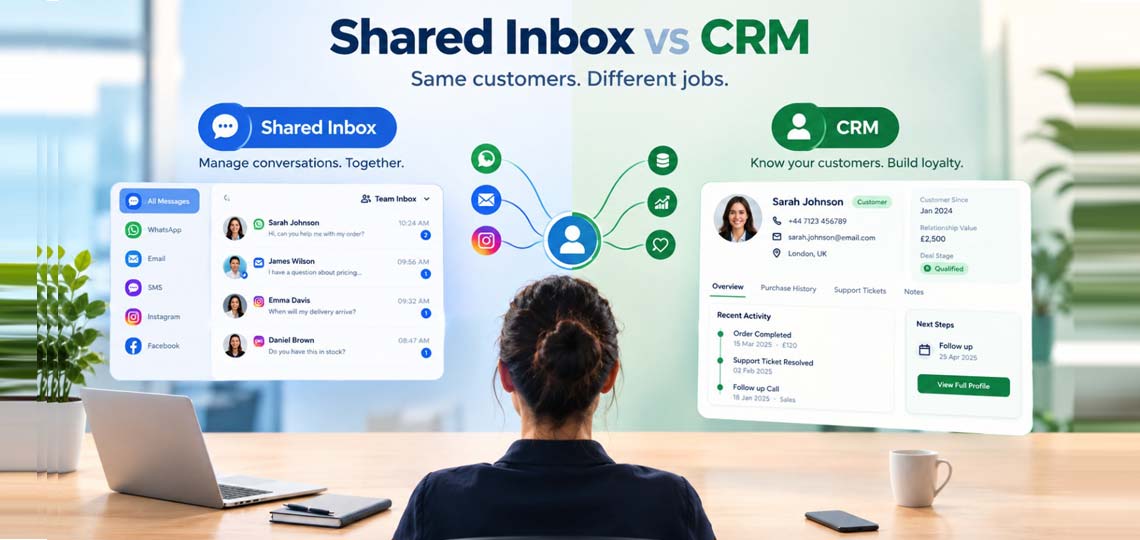
Somewhere in the process of scaling a small team into a slightly bigger one, most businesses hit the same wall. They already have a CRM, and they assume it would handle the day-to-day mess of team members replying to customers on WhatsApp and email. It doesn't, not really. Or they go the other way. They get a shared inbox tool, expecting it to double as their customer database, and six months later realise it has no idea what a customer bought last year or what deal stage they're at.
Neither tool failed. They were just never built to do the other one's job. This confusion is common enough that entire forum threads exist of businesses asking, essentially, "wait, which one of these am I actually supposed to be using?" So let's actually settle it.
What a CRM Is Actually Built For
A CRM (Customer Relationship Management system) exists to answer one core question: what do we know about this customer, and where do things stand with them? It stores structured
Signs You Need a Shared Inbox
If more than one person replies to customers from the same WhatsApp number or support email, and you've ever had two people reply to the same customer with different answers, that's a shared inbox problem. Same if a customer has to repeat themselves to a second team member because the first one's reply is nowhere to be found. This is about the chaos of live, real-time conversations with no shared visibility.
Signs You Need a CRM
If your team can't tell a returning customer's history without digging through old chats, or you're losing track of where a lead sits in your sales process, that's a CRM problem. This is about structure and memory over time, not the immediate back-and-forth of a single conversation.
How a Shared Inbox and CRM Work Better Together
The two aren't competitors; they're built for different layers of the same relationship. A shared inbox handles the real-time, day-to-day conversation: who's talking to whom, right now, across which channel. A CRM holds the longer memory: what's been bought, what's been promised, what stage things are at.
When they're connected, a team member picking up a WhatsApp conversation in a shared inbox can pull up that customer's CRM history without switching tools or asking around. This is exactly the gap Tech Pioneer's Multi-Agent Inbox is built to close: a shared inbox for managing live conversations across WhatsApp, SMS, and other channels, designed to integrate with the CRM systems businesses already use, rather than trying to replace them.
Frequently Asked Questions
Can a shared inbox replace a CRM?
Not fully. A shared inbox manages live conversations well, but it isn't built to store long-term customer history, deal stages, or purchase records the way a CRM is.
Do small businesses need both a CRM and a shared inbox?
Not always immediately, but as soon as more than one person is handling customer conversations, a shared inbox becomes necessary regardless of business size. A CRM becomes more important once you need to track customer history and sales stages over time.
Can a shared inbox integrate with my existing CRM?
Yes, a well-built shared inbox should connect with your CRM, so conversation history and customer records work together, rather than forcing your team to check two separate systems.
What's the biggest sign a business has outgrown just using email or WhatsApp without either tool?
When team members can no longer answer "did anyone reply to this yet?" without asking around, that's usually the clearest sign a shared inbox is overdue, a CRM or not.
Most businesses don't need to choose one over the other; they need the right tool for the specific problem they're actually facing today. Talk to Tech Pioneer Platforms about setting up a shared inbox that works alongside the CRM you already have.
