


When Should a Business Use AI Voice Calling Instead of WhatsApp or SMS?
Most businesses don't struggle to reach customers. They struggle to reach them in the way that actually gets a response. A payment reminder sits unread on WhatsApp. An SMS about an appointment gets ignored. A lead who filled in your form at 4 PM is already talking to a competitor by 4:30.
Sometimes the fix isn't a better message. It's a different channel. And for a growing number of situations, that channel is a phone call, now handled by AI instead of a person dialling hundreds of numbers by hand.
This guide breaks down when AI voice calling is genuinely the better choice, when WhatsApp or SMS still wins, and what Indian businesses need to know about the rules before they start.
The Short Answer
Here's the rule of thumb we use:
- If the customer needs to answer something, call them.
- If the customer needs to see something, use WhatsApp.
- If the customer just needs to know something, send an SMS
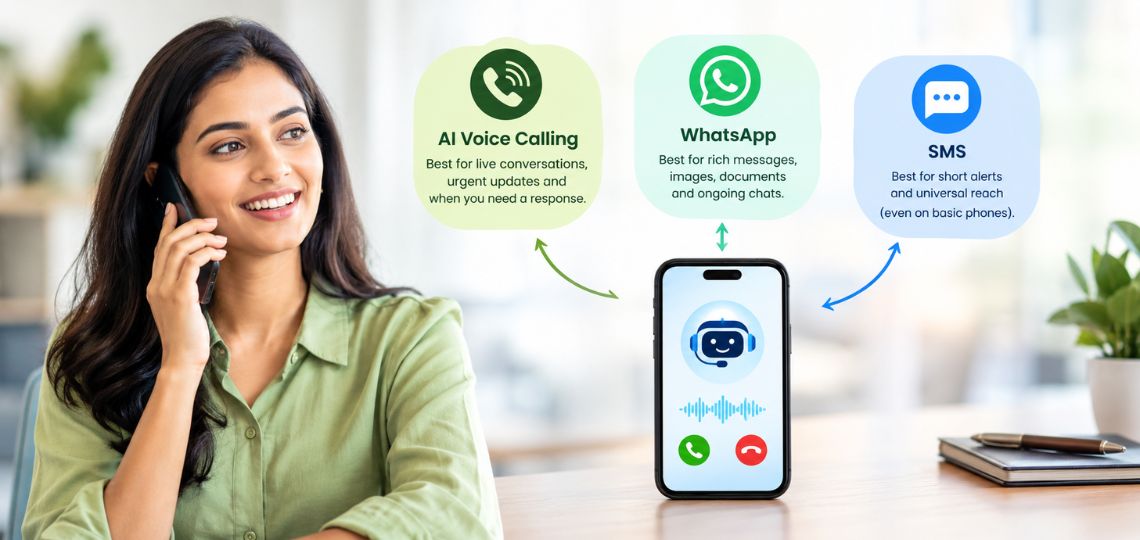
Voice is best when you need a live, two-way response or must reach someone who isn't reading messages. WhatsApp is best for rich, ongoing conversations with images, documents, buttons, and payment links. SMS is best for short, universal alerts that need to land on any phone, smartphone or not.
Everything below explains why, and where the exceptions are.
What AI Voice Calling Actually Is (and Isn't)
It's worth separating this from the two things people usually confuse it with.
An old-style robocall plays a recorded message and hangs up. There's no conversation. An IVR menu ("press 1 for sales, press 2 for support") makes the customer navigate buttons. An AI voice agent is different: it holds a conversation. It listens to what the customer says, responds naturally, asks follow-up questions, and can book an appointment, qualify a lead, or hand the call to a human when the conversation needs one.
That difference matters because it changes what the channel is good for. A recording can only announce. An AI voice agent can actually find out something, confirm something, or resolve something, at a scale one human team can't match. One industry comparison estimates a single AI voice agent can handle somewhere between 100 and 1,000+ calls a day depending on call length and platform, against roughly 20 to 30 meaningful outbound calls for a human sales rep. Treat those numbers as a ballpark, not a promise, since results vary by use case, but the scale difference is real.
6 Situations Where AI Voice Calling Beats WhatsApp or SMS
1. The message is urgent and can't sit unread
A WhatsApp message can sit unopened for hours. A text can get buried under notifications. A phone call that rings gets noticed. For time-critical situations, a missed payment deadline, an appointment starting in an hour, a delivery that needs someone at the door, a ringing phone is simply harder to ignore.
2. Your customer doesn't read messages, or prefers to talk
Not everyone lives in their messaging apps. Older customers, people in semi-urban and rural areas, and customers more comfortable in their regional language often respond far better to a spoken conversation than to text. Voice remains particularly effective where internet access and app usage are uneven, and schools, for example, often find calls more effective than SMS for reaching parents in regional languages.
3. You need to respond to a lead right now
Speed-to-lead decides a lot of sales. When someone submits an enquiry form, the business that calls first, within minutes, usually has the advantage. An AI voice agent can call a new lead almost immediately, at any hour, without waiting for a sales rep to finish another call or log in the next morning.
4. You need a back-and-forth to qualify someone
Some questions don't fit neatly into a template message. "What's your budget? When are you looking to move? Are you buying for yourself or investing?" A conversation can adapt to the answers as it goes. AI voice calling can run that kind of qualifying conversation across hundreds of leads and pass only the genuinely interested ones to your sales team.
5. You're confirming or verifying something at volume
Cash-on-delivery order confirmations, appointment confirmations, EMI or payment reminders, post-service feedback, these are repetitive, high-volume, and need a yes-or-no answer from a real person. Voice gets you that answer directly, instead of hoping someone taps a button on a message.
6. You need coverage outside working hours
Inbound calls don't stop at 6 PM. An AI voice agent can pick up, answer common questions, book appointments, and take a message or escalate, instead of letting a customer reach voicemail and move on to someone else.
When WhatsApp or SMS Is Still the Better Choice
Voice isn't always the right call, literally. Here's where the other two channels clearly win.
When the customer needs something to look at. Property brochures, product catalogues, invoices, payment links, appointment details they'll need to refer back to. A phone call is gone the moment it ends. A WhatsApp message stays in the chat, with the image, PDF, or link right there.
When the update isn't urgent. Order status, delivery tracking, a "your report is ready" note. Interrupting someone with a call for this is more annoying than helpful.
When the message is a short alert that must reach any phone. SMS works on every handset, with or without data. For OTPs, transaction alerts, and simple notifications, it's still the most universal option.
When the issue is sensitive, emotional, or complicated. A complaint, a billing dispute, bad news, a customer who's already upset. These need a human, and any AI calling setup that can't hand off cleanly to a real person is the wrong setup.
When the customer simply doesn't like calls. Plenty of people, especially younger customers, would rather not pick up an unknown number at all. For them, a WhatsApp message gets read faster than a call gets answered.
The Best Answer Is Often "Both"
The more useful question isn't "voice or WhatsApp?" but "what should happen first, and what should follow?"
A pattern that works well: the AI voice agent calls first to confirm or qualify, and then, before the call even ends, a WhatsApp message follows with the details, a payment link, an appointment confirmation, or a brochure. The customer gets the speed and directness of a call, plus the written record they'll want afterwards.
It can run the other way too. If a WhatsApp message goes unread, a follow-up call or SMS can pick it up. This kind of fallback thinking is covered in more detail in our guide on what to do when customers don't see your WhatsApp message (link once published).
The point is that these channels aren't competitors. They cover for each other's blind spots, and the businesses that get the best results are usually the ones using all three deliberately, rather than defaulting to whichever channel is most familiar.
What Indian Businesses Need to Know Before Using AI Voice Calling
AI voice calling is legal in India, but it sits inside the same rules that govern all commercial calling, and those rules have been tightening. Before launching, make sure you understand these basics.
Consent comes first. Promotional calls need verifiable consent from the customer, and numbers on the DND (Do Not Disturb) registry shouldn't receive promotional calls.
Use the right number series. Promotional calls are expected to come from 140-series numbers, while service and transactional calls use the designated service series (160 and 1600, depending on the sector). A common mistake is slipping a promotional offer into what's supposed to be a service call, which turns it into a promotional call and breaks the rules.
Be transparent that it's automated. Current guidance points toward telling the person at the start of the call that they're speaking with an automated system.
Expect stricter oversight. TRAI has recently finalised further changes aimed at spam calls, including a pre-declaration requirement for automated calls and a charge on automated bulk calling. Rules like these evolve, so check current requirements rather than relying on last year's checklist.
One honest caveat: details such as permitted calling hours and exact number-series requirements are described differently across sources, and they change. Confirm the current rules with your telecom provider or TRAI's official website before launching any campaign. This is general information, not legal advice.
The Honest Limits of AI Voice Calling
A good guide should tell you where a technology falls short, so here it is.
Language and accent coverage varies. Voice AI that handles English smoothly may struggle with a regional accent, code-switching between Hindi and English, or a less common language. Don't assume. Ask for a live demo in the languages and accents your customers actually use.
It's not built for emotionally charged conversations. If a customer is angry, grieving, or confused about something serious, a polished automated voice can make things worse. This is exactly where a clean handoff to a human matters.
It needs good setup. A badly scripted voice agent frustrates people faster than a poorly written text, because you can't skim or ignore a call the way you can a message. The conversation flow, the escalation rules, and the fallback behaviour all need careful design.
It works best with a human behind it. The strongest setups use AI for the repetitive, high-volume conversations and route anything complex to your team, with the full context passed along so the customer never has to repeat themselves.
A Quick Checklist: Should You Use Voice Here?
Ask these five questions about any message you're about to send:
1. Does it need an answer or a decision from the customer right now? If yes, lean toward voice.
2. Does the customer need to see or save something? If yes, use WhatsApp.
3. Is it a short alert with no reply needed? SMS is probably enough.
4. Is the customer likely to miss or ignore text? Older customers, regional-language speakers, and people with limited data may respond better to a call.
5. Is it sensitive or complicated? Route to a human, whichever channel started the conversation.
If you're answering "voice" to most of these for a particular workflow, that workflow is a good candidate for AI voice calling.
Frequently Asked Questions
Is AI voice calling legal in India?
Yes, when it follows TRAI's commercial communication rules: valid consent, DND compliance, the correct number series for promotional versus service calls, and disclosure that the call is automated. Promotional AI calls made without these are not compliant.
Is voice calling better than WhatsApp for lead follow-up?
It depends on the lead. Voice is stronger for immediate, urgent follow-up and for qualifying someone through conversation. WhatsApp is stronger for sharing details like brochures, pricing, and links. Many businesses call first and follow up on WhatsApp.
Can an AI voice agent hand a call over to a human?
A well-built one can. The AI handles routine queries, and when a customer needs something it can't resolve, it transfers the call to your team with the conversation context, so the customer doesn't have to start over.
